
Indi-Go Angels
A safety net made of people.
Indi-Go Angels turns concerned neighbours into a verified, coordinated search network — helping caregivers bring more trusted eyes, feet and wheels into the search for a missing child.
When every minute matters, more good people can help.
Built by Next to Kin, in support of Indigo Alert Canada’s campaign for a national alert
Why this exists
The first fifteen minutes decide almost everything.
Wandering is one of the most serious and least-supported risks facing autistic children and their families. It is not rare, and it is not slow.
Children with autism have a tendency to wander or bolt from a safe setting.
American Academy of Pediatrics, via NCMECAre never or rarely able to communicate their name, address or phone number. They cannot ask for help.
National Autism AssociationOf deaths following wandering are accidental drowning — most within a short distance of where the child was last seen, and within minutes.
National Autism Association · NCMECPolice respond. Families search. But in those first minutes there is usually no way to get more trusted people, safely and quickly, onto the right ground. That is the gap Indi-Go Angels is built to close.
Why we’re not waiting
This is not a feel-good story.
It’s a mobilisation story.
Indigo Alert Canada has spent this campaign doing the slow, necessary work — a petition past 28,000 signatures, letters to representatives in all thirteen provinces and territories, pressing for an alert system that covers vulnerable people who cannot self-rescue. That work continues, and it matters.
But a petition has never searched a ditch. A policy consultation has never checked a culvert.
We are not anti-government. Legislative change is the right fix and we are still pushing for it. We are simply not going to sit still and wait for it while another child doesn’t come home.
See a problem. Fix a problem.
Vulnerable Sector Checks take weeks. So we built two tiers.
Tier 1 — identity verification and a criminal record check — clears in minutes and can search public ground today. Tier 2 adds the police-issued Vulnerable Sector Check and is the only tier permitted to approach a child. Nobody waits six weeks to be useful, and nobody skips the check that matters.
There's no national alert for a wandering child. So we don't depend on one.
Indigo Alert Canada is fighting for that alert, and will keep fighting. Meanwhile Indi-Go Angels activates through our own verified coordinator the moment police are engaged — no legislation required, no province-by-province agreement to wait on.
Grant cycles run in quarters. Searches run in minutes.
This network is paid for by KinTag sales and subscriptions, not by a funding round. That means we answer to the families who bought a tag, and we can ship the week we're ready instead of the quarter a committee approves.
Speed and safety are not opposites here. Every control on this page — the 911 gate, the coordinator callback, the screening tiers, the instant stand-down — exists because it makes the network faster to trust, not slower to launch.
How it works
Verified first. Then mobilised.
An alert never goes straight from a frightened parent to a crowd of strangers. Every activation passes through a trained coordinator, and every Angel receives only what they need to search safely.
Zone 4 — Eastview
You will not see the child’s name, photo or home address unless the coordinator releases them.
A caregiver raises the alarm
The caregiver calls 911 first — always. The app will not proceed until they have. They then send a request to the Indi-Go Angels coordinator.
A trained coordinator verifies it
A real person calls the caregiver back, confirms the child is missing, confirms police are engaged, and records the file number. Nothing is broadcast automatically.
The gate that makes this safeNearby Angels are notified
Verified Angels close to the scene receive an alert with the minimum information needed to search. Responding is always voluntary.
Each Angel is given a zone
The coordinator assigns search areas so ground gets covered once, properly — starting with water and the confined spaces where children are most often found. No duplicated streets, no crowds in one place.
Everyone stands down together
When the child is found, a single stand-down reaches every Angel at once. Location sharing stops immediately and search data is deleted on a fixed schedule.
New — the community hazard map
Neighbours already know where the danger is.
The storm drain with the loose grate. The retention pond behind the new subdivision. The culvert under the rail line. The gap in the construction fence. None of it is written down anywhere a search team can reach at 8pm on a Tuesday.
Verified Angels map these places in advance — calmly, in daylight, in their own neighbourhoods. When a search begins, the coordinator already has the list, and Angels are sent to the highest-risk locations first instead of finding them two hours in.
Illustrative only. The real hazard register is never public — it is visible to verified Angels, coordinators and partner agencies.
Confirmed, not just claimed
A hazard reported by one Angel is only a report. It becomes part of the search register after a second verified Angel or a coordinator confirms it. Anything not re-confirmed within a year is flagged as out of date.
Seasonal by design
A dry slough in August is four feet deep in May. A pond that is frozen solid in January is lethal in March. Every hazard carries a seasonal risk profile, because on the prairies that is the difference that matters.
Prevention, not only response
A verified map of unsecured storm drains and broken pond fencing is worth something to a city long before anyone goes missing. Aggregate findings go to municipal partners so hazards can be fixed, not just searched.
Boundaries
An Angel observes and reports.
Volunteers are not police, not investigators and not rescuers. The role is deliberately narrow, and that is what makes it safe for everyone — including the child.
An Angel does
- Search a specific assigned area, carefully and calmly
- Check water, ditches and confined spaces first
- Look in the places a frightened child hides — sheds, under decks, playground equipment
- Report a sighting immediately through the app
- Stay at a distance and wait for police or the caregiver
- Stand down the moment the coordinator says so
An Angel does not
- Chase, restrain, pick up or transport a child
- Enter private property, or enter water
- Question members of the public or confront anyone
- Post about an active search on social media
- Contact the family directly
- Attend a search they have not been activated for
Every Angel completes training on autism-specific search behaviour before their first activation — because a well-meaning volunteer shouting a child’s name can push that child further into danger.
One clear status, always
You always know exactly where you stand.
No points, no rankings, no streaks. Participation is serious, voluntary and coordinated — four states, and nothing in between.
Identity confirmed, checks complete, training done. Registered but not on call.
You have marked yourself available. You will receive alerts in your area.
You have opted in to an active search. Your location is shared with the coordinator only, and only until it ends.
The child has been found. Searching stops, tracking stops, everyone goes home.
Safeguarding & privacy
The hard parts, handled first.
This system holds information about vulnerable children and about the volunteers who help them. None of what follows slows us down — it is what lets us move fast and still be trusted with a family's worst fifteen minutes.
Police-led, always
911 comes first, every time. Indi-Go Angels supplements an official response and never replaces or competes with one. If police ask us to stand down, we stand down instantly.
Verified people, not anonymous accounts
Government ID and identity verification, criminal record checks, and a police-issued Vulnerable Sector Check for any Angel permitted to approach a child. Re-screened on a fixed cycle.
Only what is needed to search
Angels see an assigned zone, an approximate description, time last seen and safety instructions. Names, photos and home addresses are released only when a coordinator judges it necessary.
Location sharing that ends
Tracking begins only when you personally join a specific search, is visible to the coordinator rather than to other volunteers, stops automatically when the search closes, and is deleted on a short published schedule.
Never sold, never repurposed
No advertising, no behavioural analytics, no resale. Search and hazard data exist for one purpose and are not reused for another.
Canadian data, Canadian rules
Data is stored in Canada and handled under Canadian privacy law, which treats children's information and precise location as especially sensitive.
Built on the Indigo KinTag
The tag reunites. The network searches.
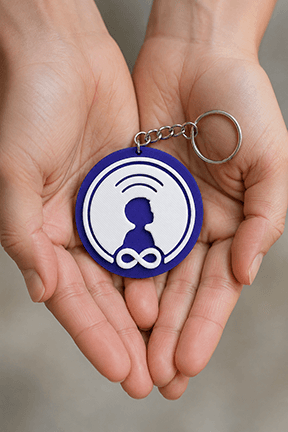
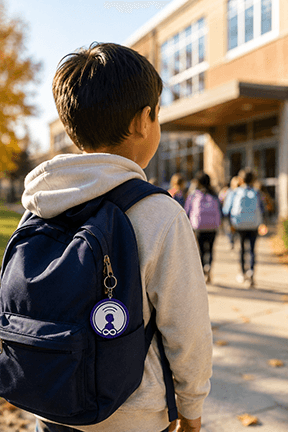
The Indigo KinTag is a simple NFC tag a child wears. Anyone who finds them taps it with a phone and reaches a caregiver in seconds. No battery, no app, no tracking.
Indi-Go Angels is the other half of the same promise. The tag turns a stranger into help once a child is found. The network brings more good people to the search that finds them.
A tag scan can end a search
When a KinTag is tapped during an active search, the coordinator is alerted instantly and can stand every Angel down within a minute.
A tag scan can start one
If a stranger scans a tag and the caregiver does not respond, that is often the first sign a child is missing at all.
How it’s paid for
Every KinTag funds the network.
Indi-Go Angels is not waiting on a grant, a gala or a government programme. It is funded directly by families keeping their Indigo KinTag active — which means the families this protects are the ones who built it.
No upfront cost
A KinTag ships free. Nothing keeps a family out.
A plan that fits
Whatever keeps a tag active — month to month, once a year, or a single payment for life — funds the network behind it.
Where it actually goes
Screening, training and coordination are the real costs; the software barely registers.
Every family that keeps a tag active puts one more screened searcher on the street — and that searcher is there for every family in the area, not just theirs.
Who we want alongside us
Moving fast doesn’t mean moving alone.
We are building now, not after a committee signs off. But there are rooms we have not worked in, and people who have done this before. If one of these is you, we want you in from the start — not consulted after the fact.
Join us
See the alert. Join the search. Help bring them home.
We are recruiting the first Angels now, in Regina, while the build is underway. Screening takes time, so the sooner your name is in the sooner you can actually be useful. Add it and we’ll come back to you with the next step, not a newsletter.